Te Ara Whakahoki Charitable Trust
Returning to identity. Restoring to purpose.
He ara hou mā ngā rangatahi — a new pathway for youth, a pathway home to identity, wellbeing and purpose.
Vision
To restore rangatahi and whānau back to identity, belonging, wellbeing and purpose.
Mission
To walk alongside rangatahi and whānau through healing, restoration and reconnection — strengthening pathways toward leadership, education, contribution and long-term wellbeing.
Kaupapa
Healing happens through
The service combines kaupapa Māori values, relational practice, trauma-informed approaches and strengths-based intervention.
Belonging
Connection
Accountability
Identity restoration
Safe relationships
Collective healing
Cultural grounding
Practical support
The framework
The 4 Pou of Healing
Four pillars guide every journey — from knowing who you are, to becoming who you are meant to be.
Pou 1
Whakapapa
Identity
Who am I?
Strengthening identity, belonging, culture, self-worth and connection.
Pou 2
Whakaora
Healing
How do I heal?
Supporting trauma recovery, emotional regulation and wellbeing.
Pou 3
Whanaungatanga
Relationships
Who walks with me?
Restoring trust, communication, accountability and family connection.
Pou 4
Whakatipu
Growth
Who can I become?
Supporting leadership, education, employment, life skills and contribution.
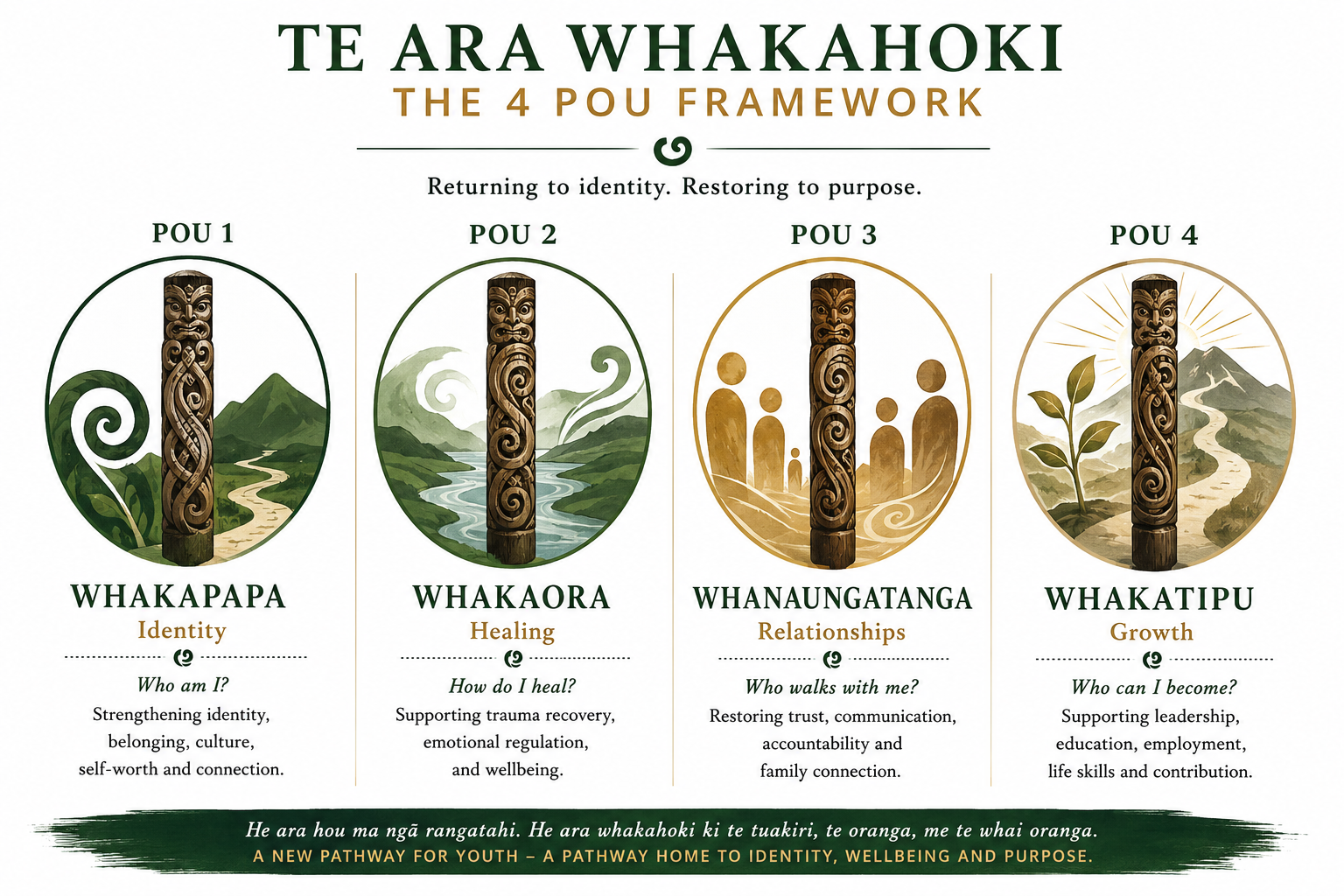

Each pou carries its own emblem — the koru of new growth, the awa of healing, the people who walk beside us, and the maunga of becoming.
Together they form one continuous pathway home: from Whakapapa through Whakaora and Whanaungatanga to Whakatipu.
Hawke’s Bay context & demand
The community need
Te Ara Whakahoki has been developed in direct response to increasing and visible need across Hawke’s Bay. Across Napier, Hastings, Wairoa and surrounding communities, rangatahi and whānau continue to face complex social pressures that are often layered, intergenerational and interconnected poverty, housing instability, family violence, disconnection from education, youth offending, poor mental wellbeing, unresolved trauma, substance misuse, whakamā, cultural disconnection and limited access to safe and trusted support. Many whānau navigate multiple systems simultaneously while carrying significant emotional, financial and practical burden.
Rangatahi are presenting with
- Higher levels of anxiety and distress
- Lower school attendance
- Disconnection from identity and belonging
- Anger and behavioural difficulties
- Involvement in, or risk of entering, the justice system
- Grief, loss and exposure to trauma
- Social withdrawal
- Suicidal thoughts and emotional overwhelm
- Family instability and disrupted care arrangements
The long-term need is supported by
- Increasing youth mental health demand
- Pressure on schools managing behavioural and wellbeing issues
- Increasing youth justice referrals
- Demand for whānau-centred support outside crisis response
- Need for culturally safe and flexible service delivery
- Limited long-term mentoring pathways for high-risk rangatahi
- Need for stronger prevention and earlier intervention
Te Ara Whakahoki recognises that these are not isolated issues. They are often symptoms of deeper disconnection and unresolved hurt. Current systems often respond once crisis has escalated. There remains a significant gap in preventative, relational and long-term wraparound support that can walk alongside rangatahi and whānau before systems escalate to statutory intervention. Te Ara Whakahoki has been intentionally designed to respond within this gap to become both an early intervention and restoration pathway that is community-based, accessible and deeply relational.
Te Ara Whakahoki seeks to respond not just to immediate need, but to the underlying drivers contributing to long-term inequity across communities.